
Maniac Magee offers many opportunities for teachers to connect with other content areas such as history and social science. In the story, Maniac Magee takes shelter at the Muhlenberg Cabins in Valley Forge National Park in Pennsylvania. It is an opportunity for teachers to review the Revolutionary War and explain about the challenges that the Continental Army had to overcome while stationary in that Valley.
From this location, twenty miles northwest of Philadelphia, the army was close enough to maintain pressure on the British yet far enough away to prevent a surprise attack. While the soldiers who entered camp on December 19, 1777, were not well-supplied, they were not downtrodden. This is attested to by an anonymous observer who recounted his visit to Valley Forge in the New Jersey Gazette on December 25:
“I have just returned from spending a few days with the army. I found them employed in building little huts for their winter quarters. It was natural to expect that they wished for more comfortable accommodations, after the hardships of a most severe campaign; but I could discover nothing like a sigh of discontent at their situation…On the contrary, my ears were agreeably struck every evening, in riding through the camp, with a variety of military and patriotic songs and every countenance I saw, wore the appearance of cheerfulness or satisfaction.”- http://www.nps.gov/vafo/historyculture/index.htm
BY JERRY SPINELLI
"...just be careful not to get the facts mixed up with the truth."- Maniac Magee quote
“You be you and I'll be me, today and today and today, and let's trust the future to tomorrow. Let the stars keep track of us. Let us ride our own orbits and trust that they will meet. May our reunion be not a finding but a sweet collision of destinies! Love and Love and Love Again, Stargirl.” - Love, Stargirl
“She was illusive. She was today. She was tomorrow. She was the faintest scent of a cactus flower, the flitting shadow
of an elf owl. We did not know what to make of her. In our minds we tried to pin her to a corkboard like a butterfly,
but the pin merely went through and away she flew.” - Stargirl
"He did not want to be a wringer. This was one of the first things he had learned about himself. He could not have said exactly when he learned it, but it was very early. And more than early, it was deep inside. In the stomach like hunger." - Wringer


“She was illusive. She was today. She was tomorrow. She was the faintest scent of a cactus flower, the flitting shadow
of an elf owl. We did not know what to make of her. In our minds we tried to pin her to a corkboard like a butterfly,
but the pin merely went through and away she flew.” - Stargirl
"He did not want to be a wringer. This was one of the first things he had learned about himself. He could not have said exactly when he learned it, but it was very early. And more than early, it was deep inside. In the stomach like hunger." - Wringer
Sunday, May 20, 2012
Muhlenberg Cabins Rear

Setting examples
The
characters of Spinelli’s novels are very captivating because they address the
common feeling and anxiety that every schoolchild has of finding friends and conforming
to peer pressure. Moreover, Spinelli’s characters, Maniac Magee, Susan Stargirl
Caraway, and Palmer LaRue (Wringer) share the same mantra of being distinct
from their social peers. At the same time that they are not considered pariahs,
they confront difficulties adapting and behaving to their peers’ expectations.
This certainly resonate to the middle school students who struggle to be accepted
by a group just like Stargirl did, and/or to others who, just like Palmer LaRue,
engage in activities that contradict with their principles because they want to
be accepted by a larger group. These characters become empowering examples for
students to find their own voice, their own path in spite of others’ choices. I
believe that these are very engaging books, which speak directly to the
anxieties and dilemmas of everyday middle school students, and as such, are
excellent choices for literature circles, author study, or read-alouds.
Wednesday, May 9, 2012
Love, Stargirl website
This is the Love, Stargirl website. There is information and activities about the book as well as fun facts and info about Jerry Spinelli.
http://www.randomhouse.com/teens/stargirl/home.html
http://www.randomhouse.com/teens/stargirl/home.html
Winter Solstice
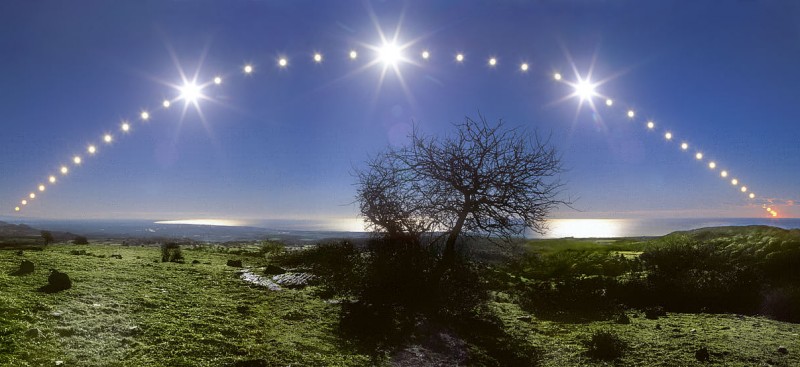
Stargirl is very in tune with nature and the cycles of the earth. A big part of her life was following the seasons. This included the summer and winter solstice. In Love, Stargirl she even woke up each morning before sunrise to mark a calendar, and held a huge winter equinox celebration! Here are some links to more information, as well as a few diagrams, about winter solstice.
http://www.athropolis.com/arctic-facts/fact-solstice-winter.htm
http://en.wikipedia.org/wiki/Winter_solstice
http://news.nationalgeographic.com/news/2009/12/091218-winter-solstice-date-2010-solstices-first-day-winter/
A diagram of the earth and sun's placement throughout the year. Winter solstice is on the right.

A picture of exposures from one day showing the sun's position during the winter solstice. When viewed from northern latitudes, the Sun will make its lowest arc through the sky along the southern horizon. This results in the shortest amount of time in between sunrise and sunset, and the fewest hours of daylight.

http://www.athropolis.com/arctic-facts/fact-solstice-winter.htm
http://en.wikipedia.org/wiki/Winter_solstice
http://news.nationalgeographic.com/news/2009/12/091218-winter-solstice-date-2010-solstices-first-day-winter/
A diagram of the earth and sun's placement throughout the year. Winter solstice is on the right.

A picture of exposures from one day showing the sun's position during the winter solstice. When viewed from northern latitudes, the Sun will make its lowest arc through the sky along the southern horizon. This results in the shortest amount of time in between sunrise and sunset, and the fewest hours of daylight.
Friday, May 4, 2012
Craft move: the altering of font
Another craft move noticed in Stargirl, Maniac Magee, and Wringer is
Spinelli’s altering of the font for specific purposes. When I say altering of
the font, I am talking about the look of letters, the size of letters, and
placement of words.
Stargirl shows how Spinelli alters the size of letters and
placement of words when he writes, “As we approached, she held up a sign, a
huge cardboard sign bigger than a basketball backboard. She set the sign on
edge an propped it up, erasing herself. The red painted letters said:
WAY TO GO,
SUSAN
WE’RE PROUD OF
YOU” (p. 159-160).
Another example of this is seen when Spinelli writes,
“Painted on the sheet in broad red brush strokes was a Valentine heart
enclosing the words:
STARGIRL
LOVES
LEO” (p. 129).
This changing of font is also seen in Maniac Magee. For example, Spinelli writes, “Only the F had been scrubbed away. The rest was quite easy to
read, the tall yellow letters the same color as the scrub bucket:
ISHBELLY GO HOME” (p.
68).
Finally, in Wringer
an example is seen when Spinelli writes, “Finger-lettered in the chocolate
icing along the side of the two-layer cake was a single word:
TONIGHT” (p. 167).
When reading Maniac Magee, readers notice that italics is used to show readers
what words are emphasized when characters speak. For example, on page 61 when
Maniac is questioned on whether he belongs in East End because of the color of
his skin. Spinelli writes, “Maniac gave his answer: “I am home” (p. 61) and later on writes, “This is where I
live” (p. 61). On that same page, font size is changed for emphasis. The man
who is arguing with Maniac about whether he belongs says, “You got your own
kind. It’s how you wanted it. Let’s keep it that way. NOW MOVE ON. Your kind’s
waitin’” (pg. 61). By capitalizing that sentence readers can picture the man
yelling extra loud when he said this. On page 65, showing which words
characters place emphasis on when they speak is continued by Spinelli when
Amanda tries to convince Maniac to remain living at her house. Spinelli writes,
“‘I’ll go somewhere.’ ‘Somewhere?
Like the deer pen?’” and “‘Well, what’re you gonna do for a pillow, huh? I know you put my pillow on the floor’” (p. 65). Also on page 65, is an example where
the narrator uses italics to help express feelings of characters. Spinelli
writes, “He was making her so mad!”
By doing this, Spinelli reiterated how angry Amanda was at Maniac for wanting
to leave because the italics show emphasis. Spinelli also uses italics in Stargirl to express that certain words are emphasized by
characters when they speak like we do in everyday speech. For example on page
98, many sentences have one word emphasized, like “What did you think, people
thought that was cute”, “It was her”, “he gestured defensively – ‘tell them’”, and “She was only a cheerleader”. Lastly, italics being used to show readers which
words are emphasized is seen in Wringer when Spinelli writes, “What has gotten into you” (p. 146), “It’s not just you (p. 147), and “But I don’t want it to be over
because then it’ll be closer to my birthday” (p.149), in addition to many other
sentences.
Although all three books, Wringer, Stargirl,
and Maniac Magee share the
presence of the craft move of using italics to highlight parts of the text, the
books have italics in different types of places. For example, whenever Spanish
is spoken in Stargirl, italics
are used. In Maniac Magee, hard
to believe actions of characters are italicized. For example, Spinelli writes,
“When the once-a-week freight train hit Elm Street, he started running from the
Oriole Street Dead End – on one rail
– and beat the train to the park, no-sweat” (p. 141). On that same page
Spinelli writes, “The mysterious hole down by the creek, the one you would
never reach into, even if you dropped your most valuable possession into it –
he stuck his hand in, his arm in,
all the way to the elbow, kept it there for the longest sixty seconds on
record, and pulled it out, dirty, but still full of fingers” (p. 141). On a
different page, Spinelli writes, “It wasn’t a trick. It was true. The kid was running on the rail” (p. 31).
Going
back to a use of italics seen in all three books, Spinelli mentions thoughts of
characters with italics. For example, on page 39 in Wringer, Spinelli writes, “little Palmer thinking, “The
boy wants it for a pet”. Looking at Maniac
Magee, some examples of this are when
Spinelli writes, “Live it up,
thought Grayson” (p. 104) and “The minister, thought Maniac. That’s who we’re waiting
for” (p. 117). One example of this in Stargirl
is when Spinelli writes on page 9, “As she
approached our table, I thought: What if she’s looking for me?” These uses of italics are used to help readers pay
more attention to thoughts. There are many other uses of italics used by
Spinelli throughout his books that I will not get into now.
Craft move: similes
A craft move noticed in Stargirl, Maniac Magee, and Wringer is Jerry
Spinelli’s use of similes. I will first demonstrate this by listing the similes
from Chapter 19 in Stargirl.
Spinelli writes, “I ran my fingertip along the hard line of his two-inch jaw,
rough like a cat’s tongue” (p. 101). Two pages later, Spinelli writes, “The
pipe bowl, like some predator, or seducer, drew down the flame” (p. 103). Just
two sentences after this, one reads, “Like so many of Archie’s words, they
seemed not to enter through my ears but to settle on my skin, there to burrow
like tiny eggs awaiting the rain of my maturity, when they would hatch and I at
last would understand” (p. 103). Soon after this sentence, one reads, “The
purple of the mountains flowed like watercolor” (p. 103). One page later,
Spinelli writes, “Archie always spoke to him with respectful formality, as to a
judge or visiting dignitary” (p. 104).
Some examples of similes being used
in Maniac Magee are seen on page 32,
page 71, and page 105. Spinelli writes, “The Cobras were laughing because they
figured the dumb, scraggly runt would get out of the East End in about as good
shape as a bare big toe in a convention of snapping turtles” (p. 32). Spinelli
also writes, “his eyes lit up like flashcards” (p.71) and “The old man gave
himself up willingly to his exhaustion and drifted off like a lazy, sky-high
fly ball” (p. 105).
Some
examples of similes seen in Wringer can be read on page 132, page 133,
and page 203. Spinelli writes, “Daffodils clustered like bugle bands in front
yards as the Beans Boys left school behind on a sunny, cloudless day” (p. 132).
On page 133 Spinelli writes, “Palmer was about to throw his vote to baseball
when suddenly the sunlight was briefly snipped, as if a page had been turned in
front of a lightbulb” and “six eyes, round as tiny planets, stared”. One more
example is seen on page 203 when Spinelli writes, “and his father was smiling
and looking down, and his hands were opening like a flower”.
Tuesday, March 27, 2012
Subscribe to:
Posts (Atom)